Ted's Flock of Geese
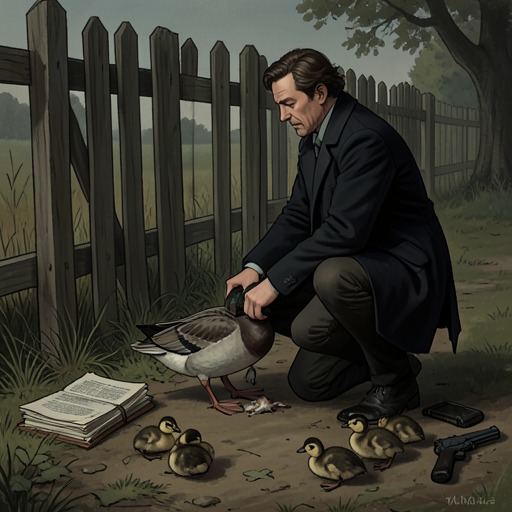
Crimson LakeTed's Flock of Geese is a small group of goslings and their injured mother, Woman, who become part of Ted Conkaffey’s household in Crimson Lake. Their relationship with him changes from accidental caretaking into a pattern of recognition and dependence: the goslings imprint on Ted and trail after him, while Woman’s alarm helps him discover an intruding python. The flock matters not simply as a domestic detail, but as a continuing, practical bond in a life shaped by isolation and public suspicion.
Arrival and Household Life
The geese enter Ted’s life unexpectedly. He says they were an accident, and recalls that, when they first arrived, he searched online for suitable food. That early act of care develops into an ordinary household presence: the birds gather on the porch, and Ted notices their movements alongside the routines of his home. When Amanda Pharrell visits his kitchen, she remarks on the geese, and Ted admits he would not have expected himself to be a bird keeper. Their exchange turns the unlikely arrangement into a shared joke; Amanda compares the geese with her cats, and they imagine that, between them, they could start a farm.
That lightness sits beside a more serious change in Ted’s responsibilities. As the goslings grow familiar with him, they begin treating him as a parental figure. Ted has learned about imprinting while looking up food for them, and recognizes the process when the birds start following him in a line from room to room. Their mother is injured and cannot move around much, so the goslings orient themselves toward Ted instead. The relationship is therefore not just his projection onto animals: the birds’ repeated behavior makes him the focus of their care-seeking and movement.
Imprinting and Reciprocal Care
The goslings’ attachment first brings Ted a practical worry. They gather around his toes whenever he stops, and he spends about an hour afraid he might step on one of them. But the birds also anticipate his movements and get out of his way. What begins as a source of anxiety becomes a familiar routine: Ted gets used to his small procession of followers. The scene marks a change in how he occupies his own home. He must pay attention not only to his own movements, but also to the dependent creatures moving around him.
The flock’s behavior becomes especially clear when Ted and Amanda watch from the kitchen. On seeing him through the open porch door, the goslings rush toward him in a straight line and gather at his feet. Amanda identifies them as imprinted; Ted confirms it, and the two watch the birds together. The moment makes the bond visible to another person. Their attention is directed toward Ted, but Amanda’s presence turns the scene into a shared observation rather than a private theory about what the animals feel.
The flock also accompanies Ted through the ordinary tasks of a tense period. The goslings follow him out to the mailbox after a vigilante attack has left the steel letterbox charred, its melted number lying across the road. Ted is investigating Jake Scully’s disappearance and facing escalating harassment at home; against that backdrop, the birds’ small, orderly procession is a striking contrast to the threat around the house. The evidence does not make them a solution to that danger. It shows instead that, even as Ted attends to the damage and continues his inquiries, the goslings remain close and dependent on him.
Woman as Guard Goose
The flock’s protective role comes into focus when Ted finds a large diamond python on a roof beam near the goslings. Alarmed, he reaches their box and counts them carefully: first all six together, then in two groups of three. All six are present. The count resolves his immediate fear for the young birds, while the scene also reveals that Woman has been sounding an alarm.
Ted understands that her agitation had been a warning. He considers himself fortunate that she continued making noise even when he had ignored her; otherwise, he thinks, the intruder might have returned with another gosling inside it. Woman’s behavior thus has a consequence beyond the human household: she detects a threat near the young and persists in signaling it. Ted calls her a very good guard goose, and the episode gives that description a specific basis in what she does.
After confirming that the goslings are safe, Ted makes a snake catcher from household items: he threads twine through the hollow handle of a plastic broom to form a loop, uses it to bring the python down from the beam, and carries the snake away from the house. The incident is also a measure of Ted’s attention to the flock. His first urgent task is to count the birds, and his relief follows their confirmed presence. The geese are vulnerable creatures in his care, but Woman is not merely passive within that arrangement; her warning helps Ted respond to the danger.
Narrative Significance
The flock’s importance develops through repeated, concrete acts rather than any claim that animals can undo Ted’s troubles. Their imprinting gives him a parental role just as thoughts of his infant daughter and the possibility of a renewed relationship with her have begun to occupy him. The parallel is one of circumstance and feeling, not equivalence: the goslings follow him because their injured mother cannot, while his relationship with his daughter remains a separate and uncertain human bond. Still, the birds make care present and daily, enacted in watching where he steps, noticing their alarm, and counting all six.
Their presence also complicates a household defined by danger and scrutiny. Ted is recognized and shunned in public, and vigilantes target his home; at the porch, meanwhile, the goslings recognize him and hurry toward him. This contrast does not erase the damage inflicted on him, nor does the narrative suggest that the geese can protect him from people. It establishes another kind of relation alongside hostility: one built through proximity, routine, and attention. The flock’s significance rests in that modest reciprocity, with Woman’s warning and the goslings’ following making Ted’s care visible in action.